
Ever wonder how they test a roller coaster? Before a coaster is even built today, computer modeling will verify things like the g-forces being within safe thresholds and that the track layout doesn’t have any “envelope” issues (places where a rider’s hands or other body parts could make contact with the structure). However, theoretical testing is not enough, practical testing is needed too. After the track is first inspected inch by inch, a car will then do a “pull-through” test, usually by a winch, to check everything. Often a large piece of plywood will be mounted on a seat to represent the maximum reach of a rider’s hands to check the “envelope” again. Then the train will cycle all or part of the course empty before the water-filled dummies below will get the first ride! Before a human sets foot on a new coaster, dummies like this will take dozens or hundreds of laps with sensors and cameras aboard to be sure everything is OK. The restraints are also tested long before construction and if you’re in the Orlando area you can potentially even help Skyline Attractions with this next Saturday, August 15, 2026!
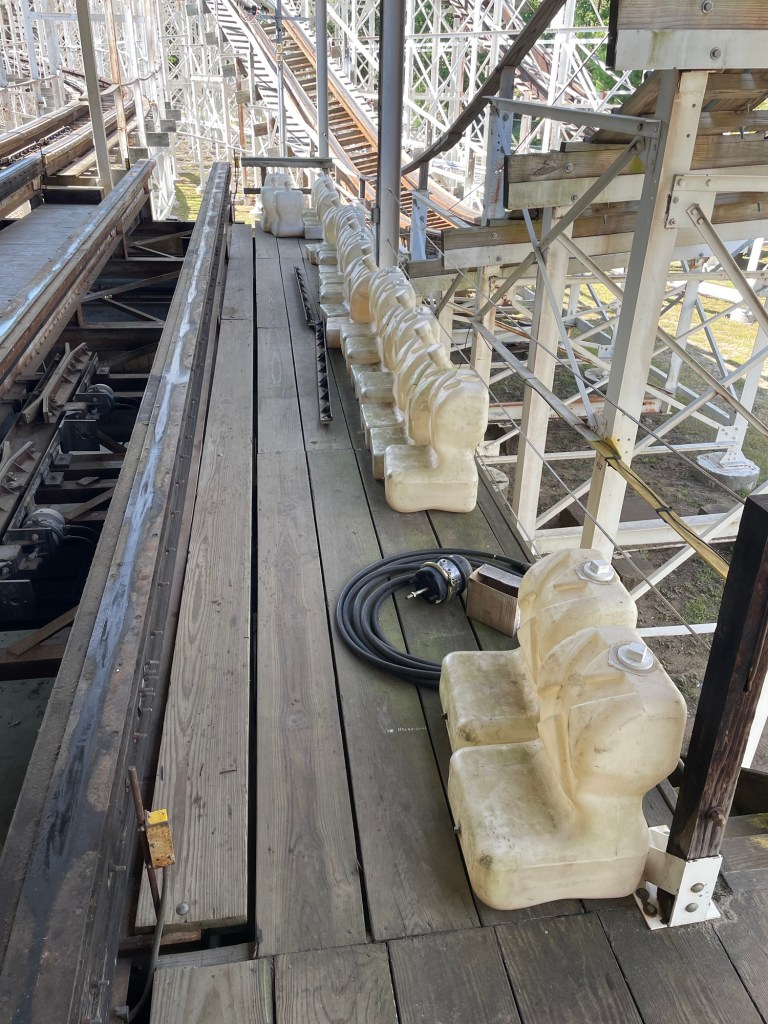
I was able to see a group of dummies near the station of Comet on a recent visit to Great Escape. These water dummies are important as a train reacts quite differently with weight than without it. A heavier train will move faster and with more force than an empty one. For example too much weight sometimes causes an “overspeed” on a coaster where it exceeds its designed desired speed. This can sometimes be managed by the control system and trim breaks (for the rides that have these mid-course brakes). This can be exasperated later in the day on hot days when grease is hot and thin. However, some rides have no means of reducing speed along the course and thus the only solution is to run with less weight. This is why you might sometimes see a couple of middle rows of your favorite coaster blocked off. It is important for a park to test with realistic weight to know where these limits are to minimize downtime.
In addition to testing the trains mechanically, it’s also important to test the restraint system. The restraints will be cycled open and closed thousands of times in testing. However, they’ll be thoroughly tested before they ever ship to the park by real people! I see every so often companies like Skyline Attractions running events looking for people to attend events to test for “containment and fit” of their restraints. They seem to especially be looking for kids near the edge of the height requirement. I can imagine “containment” is code for “can you wiggle out of this” when it comes to kids. I don’t live in the Orlando area, but if one was ever happening while we were visiting I’d love to bring my 10 year old as I think it would be fascinating!
Sometimes people are nervous about riding a new coaster like they’re some sort of test subject. However, by opening day hundreds if not thousands of people have ridden the coaster already. These include engineers, construction workers, park employees and lots of reporters and influencers on media day. Of course the first “riders” are almost always our water dummy friends though and the whole testing process usually concludes with a state or local inspection. Roller coaster testing is a long and interesting process and if one is under construction in your area be on the lookout for water dummies to know opening day is getting close!

